








State of Windshield Technology in the US and Europe 2025

Column Table of Contents
Hide
The State of Automotive Windshield Technology in the US and Europe 2025: An In-Depth Analysis Focusing on Autonomous Driving and AI
Part I: Technological Evolution and the Multifunctional Windshield
The State of Automotive Windshield Technology in the US and Europe 2025: An In-Depth Analysis Focusing on Autonomous Driving and AI
Report Executive Summary
It's 2025, and the automotive windshield is evolving from a simple safety component to a key technology platform that is revolutionizing autonomous driving, AI, and user experience. The U.S. and European markets are at the forefront of this transformation, with augmented reality (AR)-based holographic displays, intelligent smart glass, and advanced sensor integration technologies gaining traction. This report provides strategic insights into where windshield technology is headed in the future of mobility by deeply analyzing the state of the art, market dynamics, and regulatory environment in both markets.
Part I: Technological Evolution and the Multifunctional Windshield
1.1. Redefining Driver Experience with Windshield Displays
The evolution from simple HUDs to AR-HUDs
In the past, heads-up displays (HUDs) have played a limited role, primarily projecting relatively simple and static driving information onto the windshield, such as vehicle speed and navigation directions. But in 2025, this technology is rapidly evolving into AR-HUDs that incorporate augmented reality (AR). This new technology goes beyond simple projection of information to graphically overlay navigation routes on top of the actual road, or display information such as hazard warnings and pedestrian identification in real time, helping drivers intuitively recognize everything that's going on without having to take their eyes off the road.1
AR-HUDs are focused on dramatically improving driving safety by creating an environment where the driver's field of vision is matched with real-world information. A key goal of the technology is to minimize eye distraction caused by looking back and forth between traditional instrument clusters or central displays, and allow drivers to see all the information they need at a glance by simply looking ahead.1 These technological advancements are transforming HUDs from a luxury feature in premium vehicles to an important safety and navigation feature in mid- to low-priced vehicles, with more than 17 million vehicles worldwide expected to be equipped with HUD systems by 2025.2
Holographic displays: key trends at CES 2025
CES 2025, the world's largest new technology show in Las Vegas, USA, was an important stage for glimpsing the future of automotive windshield technology, and Hyundai Mobis‘ ’Holographic Windshield Transparent Display‘ technology was the culmination of this technological evolution.3 Rather than projecting information onto a small area, this technology utilizes the entire windshield as one giant display. This allows the driver to see all driving information directly through the windshield, including road conditions, weather information, navigation, and vehicle speed.5
The technology can deliver not just images, but high-quality video, and can clearly display a wide range of infotainment content in a large space, from the driver's seat to the passenger's seat.4 This heralds a fundamental shift in vehicle interior design by replacing physical displays such as traditional instrument clusters and center displays. In autonomous mode, it paves the way for new forms of entertainment for passengers, with commercialization of the technology planned for as early as 2027.6
Functional integration of displays and a paradigm shift in interior design
The emergence of advanced technologies like holographic windshield displays is more than just a functional advancement; it's fundamentally changing the philosophy of in-vehicle user experience (UX) and interior design. Traditionally, vehicle interiors have been filled with a variety of physical screens and buttons related to driving, such as instrument clusters, center displays, climate control systems, and more. But as the windshield becomes the sole, unified interface for all of this information, the interior can be reimagined as a more minimalist, open space.5
This shift is having a profound impact on the business models of not only automakers, but also tier-one suppliers that produce dashboard and infotainment system components. The accelerating shift to software-driven display solutions instead of physical hardware is creating new competitive and collaborative models throughout the technology supply chain. As the windshield becomes the ‘glass interface" for all information, passengers will experience a completely new form of mobility as they move between driving and autonomous modes.
1.2. The Rise of Intelligent Smart Glass
Diversify your technology: SPDs, PDLCs, and electrochromics
In 2025, the automotive glass market will go beyond just providing transparency and incorporate a variety of smart technologies to ensure convenience and safety. Smart glass is also known as ‘switchable glass,’ which uses electrical signals to adjust transparency and tint.8 The main technologies include Suspended Particle Device (SPD), Polymer Dispersed Liquid Crystal (PDLC), and Electrochromic.9
SPD technology is excellent at blocking light and heat by dispersing microscopic particles inside the glass and then controlling the arrangement of these particles with electrical signals. This is effective in allowing drivers to control the amount of sunlight to reduce glare, while simultaneously blocking solar heat gain to control cabin temperature.8 PDLC technology, on the other hand, is optimized for instant privacy by changing the arrangement of liquid crystal molecules in response to voltage, which can switch the glass state from opaque to clear in an instant.9 Electrochromic technology uses an electrochemical reaction to gradually change the color of the glass to adjust the transmittance, and all three technologies have the advantage of providing a clear view without the obstruction or light bleed that can be a problem with traditional thermal inserts.11
Energy Efficiency Solutions for the Car of the Future
More than just a convenience feature, smart glass technology plays an important role in addressing the energy efficiency issues at the heart of future vehicles. Especially for electric vehicles, reducing the power consumption of the heating and cooling system to maintain interior temperatures is critical, as battery consumption directly impacts range. Smart glass, such as SPD technology, can dramatically reduce battery consumption by effectively blocking solar heat gain, reducing air conditioning usage.8
Similarly, metal-coated heated glass provides winter defrosting and moisture removal through technology that heats the glass itself, while simultaneously blocking solar energy to keep room temperatures from rising.11 These energy management capabilities are helping to elevate the status of glass technology in the electric vehicle era as a strategic component that directly improves driving performance, rather than just an accessory to the vehicle.
Increasing the strategic value of smart glass
While smart glass was once considered an ancillary feature of luxury vehicles, it is now increasingly valued as a strategic component that directly improves ‘range," a key performance indicator for electric vehicles. This shift is driving closer collaboration between automakers, glass manufacturers, and technology providers, as reducing the load on the heating and cooling system through holistic thermal energy management of the vehicle is one of the most effective ways to increase battery efficiency. 8, and accelerating the race to develop the technology. Smart glass is no longer just an option, it is becoming an integral part of the future of mobility.
1.3. Sensor Integration through the Windshield: The Eyes of Autonomous Driving
Standardizing and requiring calibration of ADAS cameras
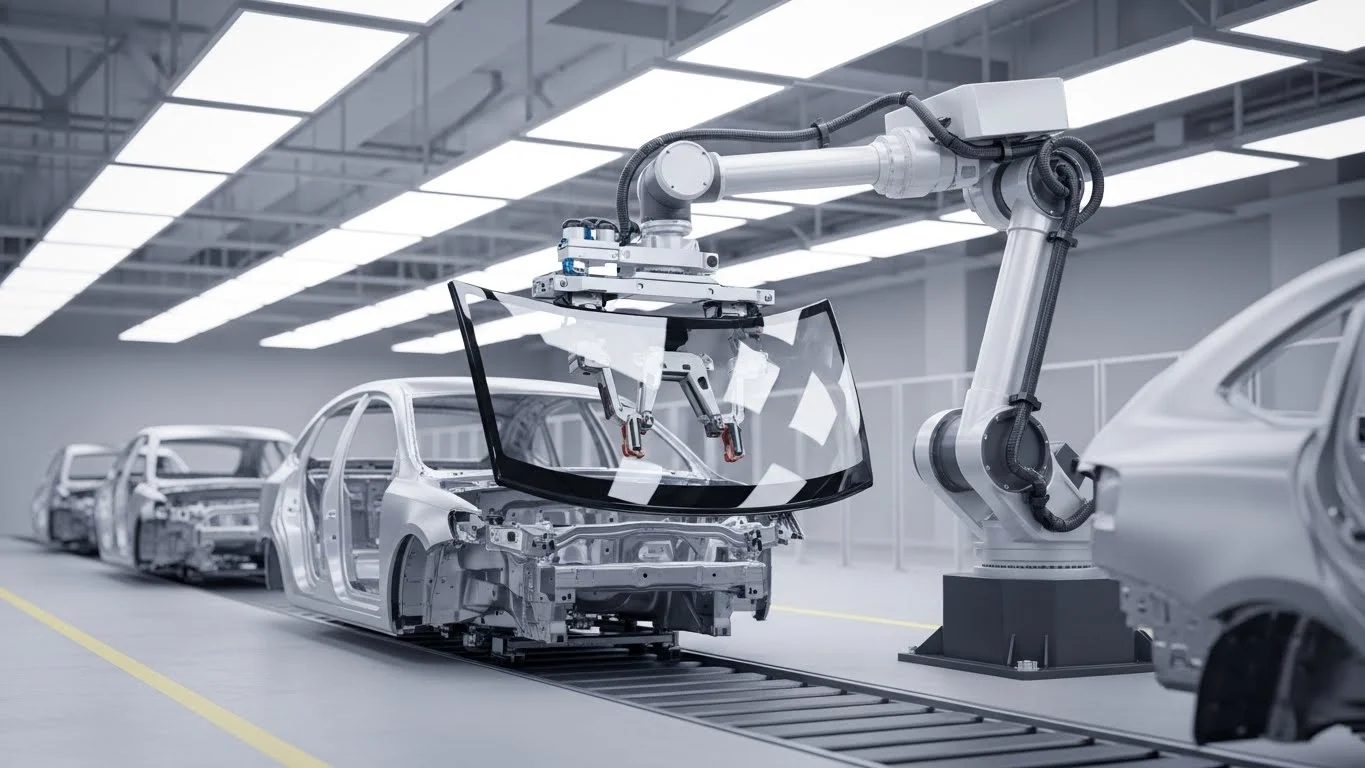
As advanced driver assistance systems (ADAS) have become more common, the prevalence of windshield-mounted cameras has skyrocketed.14 These cameras serve as the ‘eyes of autonomous driving,’ performing key safety-critical ADAS functions such as lane-keeping assist (LKA), forward collision warning (FCW), and automatic emergency braking (AEB).16
To ensure the precise operation of these camera systems, a ‘recalibration’ (ADAS calibration) is essential to accurately reset the field of view and position of the cameras when the windshield is replaced. In the U.S. and Europe, this is recognized as a mandatory safety procedure, as an improperly calibrated camera can provide incorrect information and cause a major accident.14 Recalibration is performed either statically (using specific targets) or dynamically (through actual driving), with costs varying depending on the complexity of the vehicle make or model.17
In-glass integration of LiDAR and radar
Light detection and ranging (LiDAR) and radar sensors are a key component of autonomous driving technology. In the past, large sensors were often attached to the roof of the vehicle, but recent advances in miniaturization have allowed them to be integrated behind the windshield, in the headlights, and other locations that don't detract from the aesthetics of the vehicle.19 Leading companies like AGC are solving the technical challenges with solutions that efficiently and unobtrusively integrate LiDAR sensors into windshields or roofs.21
These sensors leverage the best of both camera and radar to enable faster, more precise, and longer-range object detection.20 However, challenges remain: the development of laser wavelengths for higher resolution and longer range detection, and technical improvements to minimize the impact of glass on the sensor's performance.22 Nevertheless, the in-glass integration of LiDAR is seen as an important technological step forward that satisfies both the design and autonomous driving performance of the vehicle.21
Modernization of the glass replacement market and new business models
The proliferation of ADAS cameras has transformed windshield replacement from a simple ‘repair’ task to a ‘sophisticated technical service'.14 This creates a new revenue model for the glass replacement market and highlights the importance of aftermarket service providers with specialized skills and equipment.24 In the past, it was just a matter of replacing the glass, but now it involves complex technical work such as camera calibration, sensor alignment, and more, making the service more specialized and valuable.
This shift suggests that the proliferation of ADAS technologies is creating a new value chain not only for automotive component manufacturers, but also for the entire repair and aftermarket service industry. Those with specialized equipment and skills will be able to provide consumers with safety assurances, while also offering value-added services that are distinct from the traditional simple replacement of parts.17
Part II: Market and Regulatory Landscape Analysis
2.1. Market Size and Growth Trends
Explosive growth in the HUD market
The automotive HUD market is estimated to grow from $888 million in 2023 to $997 million in 2025, and is expected to surpass $2 billion by 2032. This growth trajectory reflects a compound annual growth rate (CAGR) of 10.221 TP3T from 2024 to 2032.2 This growth is driven by the adoption of augmented reality (AR) technology and increasing consumer demand for technological innovation. By 2025, 17 million vehicles worldwide are expected to be equipped with HUD systems, up from less than 9 million in 2021.2
Size and characteristics of the North American market
The North American automotive glass market is expected to reach approximately $6.26 billion in 2025, growing at a CAGR of 7.171 TP3T through 2030.24 The U.S. in particular is considered to have the strongest revenue potential per unit due to the high volume of premium vehicles sold.2 Laminated Glass still holds the largest share of the market, with a share of 57.251 TP3T in 2024. However, Smart/Switchable Glass is gaining traction, with the fastest growth rate of 8.661 TP3T per year through 2030.24
Leading and democratizing technology in the premium market
The U.S. market has a high adoption rate of HUD technology in premium vehicles, reaching 431 TP3T.2 This shows a typical pattern in the market, where new technologies are first adopted in the premium segment and then gradually spread to the middle and economy segments. This diffusion is driven by the development of cost-optimized technologies and increasing consumer acceptance of the technology.2 Premium markets therefore provide an important opportunity for early market entry and technology validation of new technologies, making them an important strategic location for companies developing new technologies.
2.2. Key Regional Players and Strategic Positioning
Leading manufacturers in North America and Europe
The automotive glass market is dominated by a handful of global companies driving technology development. The traditional glass manufacturing powerhouses of the US and Europe include companies such as Guardian Glass LLC (US), Corning Incorporated (US), Webasto Group (Germany), Schott AG (Germany), and Saint-Gobain (France).5 They are market leaders in their respective core technologies.
- Corning: Corning is focusing on the application of Gorilla Glass, produced through its proprietary Fusion Process, in automotive exteriors and interiors to reduce weight and increase durability.28
- Saint-Gobain: Saint-Gobain Sekurit is contributing to energy efficiency by developing technologies that can reduce the overall weight of a vehicle by up to 6 kg with its lightweight glass solutions. It is also improving thermal management in vehicles with its infrared reflective coating technology.13
- AGC (Asahi Glass): AGC has a large share of the laminated glass and tempered glass market and is driven by safety, design, convenience, and environmental performance.29 In particular, the company is actively preparing for the era of autonomous driving with its Wideye™ solution, which integrates LiDAR sensors into the windshield or roof.21
- Guardian Glass: Through smart glass technology, Guardian Glass offers a range of benefits, including glare reduction, temperature control, and energy efficiency, and is helping to make vehicles safer and more sustainable at the same time.12
The importance of strategic partnerships
As automotive windshield technology becomes more complex, it is increasingly difficult for a single company to develop all of the technology in-house. As a result, close strategic partnerships between technology suppliers and automakers and component manufacturers are becoming a key driver to accelerate the commercialization of advanced technologies. The agreement between Hyundai Mobis and German optics company ZEISS to jointly develop holographic HUD technology is a prime example.6 This collaborative model maximizes synergies by combining complex display and optical technology expertise with vehicle integration capabilities, and will set the standard for future market leadership.
Key market players and strategic positioning
| Company name | Headquarters locations | Featured technologies | Strategic focus |
| AGC | Japan | Laminated and tempered glass, LiDAR/FIR integrated glass, 5G antenna embedded glass | Sensors and connectivity for the autonomous era |
| Saint-Gobain Sekurit | France | Lightweight glass, infrared reflective coating, acoustically enhanced glass | Improve energy efficiency, sustainability, and ride quality |
| Corning | United States | Gorilla Glass | Lighter, more durable, in-vehicle displays |
| Guardian Glass | United States | Smart glass, thermal control glass | Energy efficiency, safety, and advanced design |
| Hyundai Mobis | United Kingdom | Holographic windshield displays, ADAS cameras and sensors | AR display, autonomous driving sensor integration solutions |
| Webasto Group | Germany | Smart glass, sunroof systems | Meeting the thermal and acoustic requirements of electrified platforms |
2.3. Regulatory Environment and Safety Standards
Strict tinting regulations
The United States and Europe have strictly regulated visible light transmission (VLT) requirements for windshields to ensure the visibility of vehicle drivers. In the US, standards vary by state, but in most states, the front and front seat side glass must have a light transmittance of 701 TP3T or better.31 In California in particular, windshields are only allowed to be tinted on the top 4-5 inches, and even then only on non-reflective materials.33 Europe also mandates a windshield transmittance of 751 TP3T, with Germany and the UK enforcing strong penalties for offending vehicles, such as driving bans and on-site film removal.31 The purpose of these regulations is to promote safety by ensuring that drivers and police have a clear line of sight and minimizing obstructions.32
Safety standards and the legal significance of ADAS calibration
The ECE R43 regulation of the United Nations Economic Commission for Europe (UN/ECE) covers uniform principles for the approval of automotive safety glass materials and their installation in vehicles.34 This regulation states that all glass materials must minimize the risk of personal injury in the event of breakage and be sufficiently resistant to normal traffic and environmental conditions.34
Also, for vehicles with integrated ADAS systems, ADAS calibration after windshield replacement is essential for safety.14 This is because without proper calibration, ADAS cameras can see the wrong information and cause system malfunctions or even major accidents. It's not just about driver safety, it's about the lives of others, which is why professional services are being emphasized in the U.S. and Europe.14
Regulation is both an enabler and constraint to technological progress
Strict tinting regulations pose a significant challenge to the development of advanced smart glass technologies. At the same time, however, these regulations are also a driver for new technological innovations that meet legal standards while enabling functionality, such as metal-coated heated glass that provides solar protection without obstructing the driver's view, or smart glass technologies that dynamically adjust transmittance.8
However, the lack of regulation can lead to potential safety issues. How Texas is eliminating safety inspection mandates for non-commercial vehicles starting in 2025 36Despite the importance of ADAS calibration, it poses a potential safety risk in regions where it is not legally mandated, due to a lack of driver awareness. This demonstrates the need for regulatory frameworks to be flexible and updated to keep pace with technological advances.
Part III: Strategic Implications and Future Outlook
3.1. Key Challenges and Opportunities
The evolution of automotive windshield technology presents a number of challenges. First, the complexity of glass incorporating advanced displays and sensors drives up production costs, which impacts the final vehicle price.12 Second, ensuring durability is critical to maintain performance in extreme weather conditions. Third, there is the technical challenge of seamlessly integrating the new system with the existing vehicle's electronic systems.12
However, these challenges also represent a huge market opportunity. As the level of autonomous driving increases, the demand for windshield-based sensor solutions will continue to grow. Smart glass technology, in particular, is becoming a key driver of new markets by improving the energy efficiency of electric vehicles. The windshield replacement market is also shifting from a simple part replacement to a high-value technical service, creating new revenue models.24
3.2. Future Outlook (2025-2030)
The year 2025 will mark a paradigm shift in automotive windshield technology. Beyond the traditional functional lightweighting and safety benefits, the windshield will be fully positioned as an ‘interactive platform" that provides information, control, and entertainment.
As autonomous driving technologies become more advanced, the windshield will serve as a key sensor hub to collect data from outside the vehicle, while also acting as an interior display to provide new types of experiences for passengers. Despite technical challenges and regulatory constraints, the automotive industry's transition to electrification and software-driven vehicles (SDVs) will accelerate this transformation. Windshield technology will become more than just a part of the vehicle; it will be a key factor in determining the value of future mobility.
3.3. Strategic recommendations
- Technology companies: Close collaboration with automakers and technology specialists from other sectors should speed up technology commercialization. It is especially important to complement the expertise required for complex system integration with external partnerships.
- Aftermarket services: We need to build capabilities for new technical services, such as ADAS calibration, to transform the simple glass replacement market into a high-value technical service market. Training specialized personnel and acquiring equipment is essential.
- Regulatory authorities: A flexible regulatory framework that considers safety and functionality at the same time is needed to keep pace with technological advances. Efforts are also needed to increase consumer safety awareness through increased awareness campaigns on essential safety procedures such as ADAS calibration.
Share to social accounts


Love this appreciation for great content
Thanks so much! I just checked out your fleet services — looks like you do great work for commercial vehicles.
Your writing is so inspiring and motivating I always leave your blog feeling more determined and resilient
Thank you for the compliment. We will also be sure to take a look at your platform!
I’ve come across many blogs, but this one truly stands out in terms of quality and authenticity Keep up the amazing work!